Insurance and Safety for Cleaning Rainy London Services
 Cleaning Rainy London presents unique challenges for an insured gardening company operating across the capital. In damp, cool conditions the risk profile changes: surfaces become slippery, fungal growth can increase, and equipment requires extra care to remain safe and effective. Our policy overview explains how a professional, fully insured garden and cleaning service mitigates those risks with robust cover, consistent staff training and a documented risk assessment process tailored for rainy conditions in London.
Public safety and client reassurance come first. As a responsible Rainy London cleaning provider we maintain comprehensive public liability insurance and employer’s liability cover to protect both clients and workers from the financial consequences of accidental damage or injury. This insurance is fundamental for any insured gardening company providing cleaning and maintenance in wet-weather environments across London’s streets, parks and private gardens.
 Underpinning our insurance is a commitment to prevention. Public liability insurance is not a substitute for sensible safety practices; rather it works alongside them by covering costs when prevention is not enough. Cleaners and gardeners working on slippery paths, wet decking or muddy lawns after rainfall are trained to identify hazards, apply controls and act to reduce exposure — ensuring that our Rainy London cleaning teams are less likely to trigger a claim in the first place.
Staff training is the backbone of safe operation for any insured garden services provider. We require structured induction, practical on-site coaching and periodic refreshers that cover wet-weather specifics: correct footwear selection, ladder safety on damp surfaces, safe chemical handling when controlling moss and algae, and careful tool storage to avoid trip hazards. Emphasising both theory and hands-on practice produces competent crews able to deliver consistent, safe cleaning in rainy London settings.
Training modules include scenario drills for rainy-day incidents, first aid basics for cuts and slips, and clear communication protocols so that teams working across multiple boroughs remain coordinated. Our approach to training is documented and audited, which strengthens our position as an insured gardening company that reduces risk through worker competence and procedural clarity.
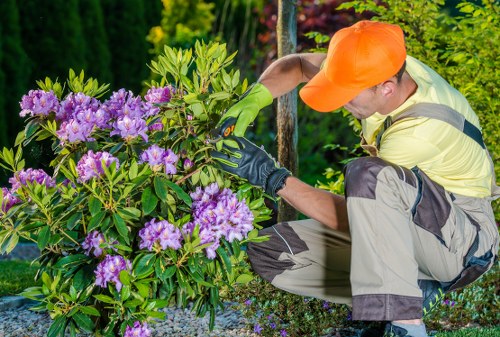
 Personal protective equipment (PPE) is another visible safeguard. In the context of cleaning in rainy London, PPE goes beyond standard gloves and hi-vis vests: anti-slip boots, waterproof outer layers, insulated gloves for chilly damp conditions and eye protection where spraying or debris removal is involved are essential. We maintain PPE inventories, replace worn items promptly and log issue dates to ensure every operative has appropriate gear before work begins.
Risk assessments are systematic and dynamic. For Cleaning Rainy-London jobs we perform a two-stage process: a generic site assessment followed by a bespoke on-the-day check. The generic assessment examines historical hazards, access considerations and weather-dependent risk trends; the on-the-day check captures immediate conditions such as standing water, wind, recent heavy rain or sudden temperature drops that affect surface traction and worker comfort.
The risk assessment process is recorded using standardised templates that list identified hazards, the likelihood of harm, existing controls and required additional measures. Controls range from simple signage and cordons to scheduling changes that move high-risk tasks to drier windows of the day. Keeping a clear audit trail of these decisions reinforces our role as a fully insured gardening company and supports legitimate insurance claims should unforeseen incidents occur.
 Safety measures also include emergency response planning and regular equipment inspections. We inspect power tools for moisture ingress, test ladders for secure footing on wet ground, and ensure water-sensitive electrical systems have appropriate isolation. Quick incident reporting and a structured investigation process help us learn from near misses and refine our Rainy London cleaning protocols continually.
 A short checklist summarises the core elements any client should expect from an insured gardening and cleaning contractor operating in wet weather:
- Valid public liability insurance with cover limits appropriate to the scale of work and risk exposure.
- Documented staff training and refresher programmes focused on wet-weather hazards.
- Comprehensive PPE provision and replacement policy.
- Clear, recorded risk assessment process with day-of adjustments.
- Equipment checks and a rapid incident reporting and review system.
Ultimately, reliable Rainy London cleaning is a blend of insurance protection and proactive safety culture. An insured gardening company that emphasises training, maintains proper PPE, and follows a rigorous risk assessment process reduces injury, limits damage, and delivers peace of mind for clients and operatives alike. By combining adequate public liability cover with transparent safety practices, such providers demonstrate professionalism while keeping London’s wet-weather green spaces and urban surfaces safe and well-maintained.
Why public liability and proactive safety matter
Public liability insurance protects clients and the community from the financial fallout of accidental damage or injury; proactive safety measures dramatically lower the chances that cover will be needed. From the perspective of both risk management and operational excellence, the most effective Rainy London cleaning companies treat insurance and safety as two sides of the same coin.
Commitment to continuous improvement
Strong companies embed a culture of continuous improvement: regular audits, updated training for the latest wet-weather techniques, evolving PPE standards and iterative risk assessments. This continuous loop of review, learn and improve is what sets an accredited, insured gardening company apart in the busy environment of London’s rainy seasons.
Cleaning Rainy London requires attention to detail, legal and moral responsibility for safety, and the right insurance structures. When these elements are in place, clients, operatives and the public all benefit from safer, more reliable services.